Japanese Legends: Cursed Places & Real Killers — Midnight Compendium, Volume OneGet the complete book · ¥790
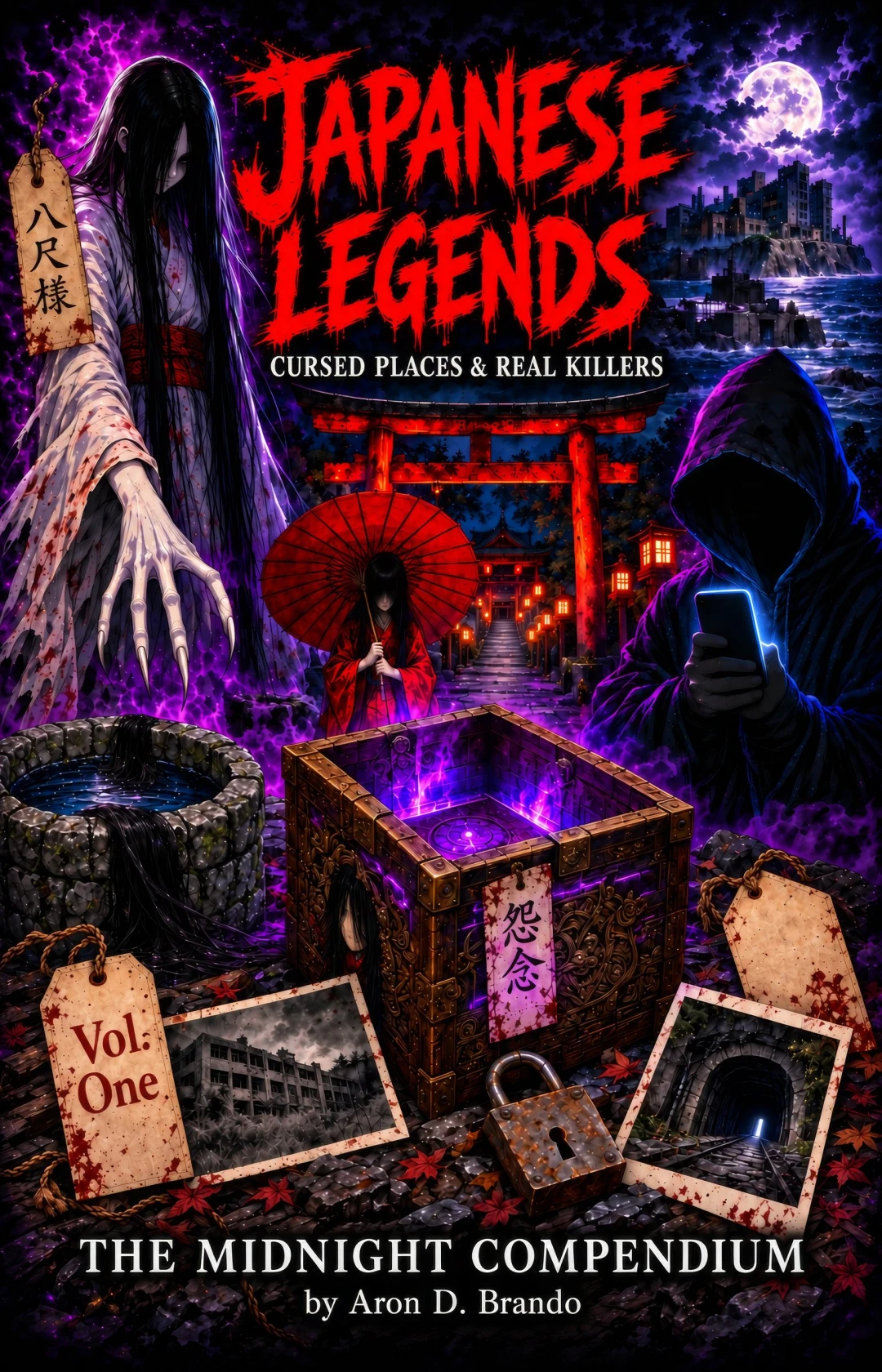
Japanese Legends: Cursed Places & Real Killers — Midnight Compendium, Volume One by Aron D. Brando

Free sample: the opening pages and first story from the revised edition.

Contents ↑

Japanese Legends

The Midnight Compendium · Volume I

CURSED PLACES & REAL KILLERS

By Aron D. Brando

Japanify Ghost Tours

Twenty-eight stories in three chapters

Revised edition · 2026

Copyright © 2026 Aron D. Brando · Japanify Ghost Tours. All rights reserved. No part of this book may be reproduced, distributed, or transmitted in any form without the prior written permission of the publisher.

Chapter I retells modern folklore. Chapter II retells legends attached to real places. Chapter III describes real crimes and real people, drawn from court records and contemporary reporting. Nothing in it is intended to glorify any act or any perpetrator.

japanifyghosttours.com

Contents ↑

A Word of Warning

Read This First

Not everything in these pages is fiction.

The first two chapters deal in the older fears: ghosts, curses, cursed objects, and the stories people whisper to keep the dark at a distance.

The third chapter is different. It steps out of folklore and into the real world. It contains murder. It contains suicide. It contains children who never came home. It names real places where real people suffered, disappeared, or died.

These stories were not included for shock. They were included because some darkness should not be cleaned up, softened, or forgotten.

Every place in Chapter II is real. Every crime in Chapter III happened. After each story you will find a section called The Truth Behind the Fear, and a short case file with dates and locations, for those who want to know what really happened.

Read slowly. And if something in these pages comes too close, close the book, step away, and breathe.

The dark is patient. It will still be here when you come back.

Contents ↑

Image Disclaimer

About the Pictures

The illustrations in this book are not evidence.

The photographs in the Chapter II case files are different. They are real photographs of real places, credited where they appear.

The illustrations were created with artificial intelligence to support the atmosphere of the stories, and then checked and corrected by hand. Signs, labels, and dates that appear in them were edited to match the facts in this book. Even so, they are illustrations: not photographs, documentary records, or accurate reconstructions of real events.

Some are inspired by real locations. The images that accompany the true-crime entries are symbolic and heavily stylized. They are not portraits of any real person, and they are not meant to make anyone famous.

They are meant as a warning. Evil does not always arrive with a monster’s face. Sometimes it looks ordinary. Sometimes it has a normal job, a polite manner, and a human name.

The writing is the record. The pictures are only shadows.

Contents ↑

Before You Begin

Introduction

Japan does not bury its ghosts. It names them.

It gives them roads, tunnels, bridges, forests, apartments, schoolyards, shrines, and abandoned rooms. It lets them settle into a place until the place itself seems to remember.

This book is about those places, those stories, and the things people still whisper about when the lights are low.

Some are legends. Some are curses. And some are true.

That is where this book becomes harder to read.

Every story is followed by The Truth Behind the Fear, where we open the door a little wider and look at what is actually known: where a legend was first told, who first told it, what really happened at a place, and what was exaggerated or invented to make the truth easier to live with. Where a story is tied to a real location, the case file tells you where it is and whether you can still go there.

Each case file also gives two ratings. Fear is how frightening we find the story. Truth is how much real, documented history stands behind it. A high Truth score never means the ghost is real.

The people in the stories of Chapters I and II are invented, as the people in ghost stories always are. The places are not.

Read the legends with curiosity. Read the cursed places with respect. And when you reach the true crimes, read them carefully.

Open the book wherever you like. The old stories will find you either way.

Contents ↑

Why We Walk at Night

A Note from the Founder

I live in Japan, and for years I have been collecting the stories in this book: the ones whispered on night trains, posted at three in the morning on anonymous message boards, carved onto memorial stones nobody reads, and told by old people who lower their voices when they get to the end.

For a while now, we have been sharing them the only way that really works: on foot, after dark, in the places where they happened. We started with ghost tours in Kyoto, a city of temples where almost every street corner has a story about something that never left. Then came Kanazawa, with its old samurai lanes and geisha districts. Now we walk in Osaka too, and more cities are coming.

On every walk, the same thing happens. The group goes quiet at the scary part. And then they go quieter at the true part, when we explain what actually happened at the spot they are standing on. That second silence is the reason this book exists.

Japan’s ghost stories are not just entertainment. They are how people here remember the things they could not say out loud: the servant punished for a crime she did not commit, the children no one counted, the village that turned its back on one of its own. Every legend is a door. Behind most of them is a real person.

So read this book the way we walk: curious, respectful, and ready for the truth to be worse than the ghost.

And if you ever come to Japan, come and walk with us. Some stories only finish when you are standing in the place where they began.

Aron D. Brando Founder, Japanify Ghost Tours

Contents ↑

A Dark Timeline

Twelve Centuries of Fear

862 — Osorezan’s temple is founded on the border of the dead. 20

864 — Mount Fuji erupts. The lava will become Aokigahara. 14

1505 — Okiku dies, says the marker at her shrine in Himeji. 18

1500s — The Takeda mine gold above the Oiran-buchi gorge. 19

1868 — The Oki uprising. In the legend, the first child-taking box is made. 09

1890 — Mitsubishi buys Hashima and starts mining under the sea. 15

1895 — A prison is built where Sunshine 60 now stands. 17

1919 — Saijō Yaso publishes “Tomino’s Hell.” 02

1938 — One night in May, thirty people die in Kaio. 28

1945 — Bodies and bones are buried beside Toyama Park. 11

1948 — Infant bodies are found on an undertaker’s bicycle. 24

1948 — Seven men are hanged at Sugamo Prison. 17

1965 — Komatsu Sakyō writes “Cow Head.” 07

1970 — The first coin locker baby is found in Shibuya. 10

1974 — The last residents leave Hashima. 15

1975 — The Nakagusuku hotel is abandoned. 16

1978 — Sunshine 60 is completed. 17

1988 — A young man is killed at the old Inunaki Tunnel. 12

1989 — Bones are found at Toyama. A father stops a stranger. 11 · 22

1996 — Deaths begin in a Kitakyushu apartment. 21

1997 — A head is left at a school gate in Kobe. 26

2000 — The NNN broadcast is posted online. 04

2005 — The Kotoribako story is posted. 09

2008 — Hasshaku-sama is posted. 01

2017 — Nine people vanish into an apartment in Zama. 25

2019 — Fire at Kyoto Animation. 23

2025 — The Twitter Killer is executed. 25
Contents ↑

Chapter I: Forbidden Legends

Contents ↑

01. Hasshaku-sama · The Eight-Foot Woman

八尺様

The first thing is the sound. A high school boy is spending his spring break at his grandparents’ house, out where the houses sit far apart and the rice fields run up to the hills. He is in the garden in the long light of early evening when he hears it from the other side of the hedge. A low voice, flat and empty, with no warmth of any person in it. Po. Po. Po. Over and over, patient, almost like laughter with everything human boiled out of it.

He looks up, because of course he does. Over the top of the hedge, which stands taller than a grown man, there is a hat. A wide white sun hat, and beneath it a woman in a white dress, looking down at him. She is smiling, and she is far too tall. The hedge reaches past most people’s heads. It does not reach her shoulders. She does not move. She keeps smiling and going po, po, po, and his body understands before his mind does that he has to be inside, now.

When he tells his grandfather what he saw, the old man’s face does something the boy has never seen an adult’s face do. It empties. The grandfather makes a phone call in a voice the boy is not allowed to hear. An old woman from the village arrives within the hour, and then the rules begin.

They put the boy in an upstairs room and cover the windows. They paste paper talismans over the door and across the walls, set a small pile of salt in each corner, put a little Buddha statue on a box in front of him, and give him a paper talisman to hold. He is told the rules once, plainly, the way you tell a child something you cannot afford for him to get wrong. Do not leave this room until seven in the morning. Do not open the door. And whatever you hear out there, whatever voice it uses, do not answer.

The night is very long. For a while there is only his own heartbeat. Then, late, the sound finds the room. Po. Po. Po. Just outside the window, on the second floor, where no one could be standing. Something taps on the glass. And then it stops being patient and starts using voices. His grandfather’s voice, telling him it is all right now, he can come out. The voice is almost perfect. Almost. Underneath it is the same flat note as the po, po, po. He grips the paper talisman in his hand so hard it tears at the edges, and he does not answer. In the morning, the talisman has turned black.

At seven, his grandfather opens the door. Outside the house, several men from the family are waiting with a van. They seat the boy in the middle, surrounded on every side, and tell him to keep his eyes closed. They drive slowly out of the village. More than once, through the window, he hears it: po, po, po, keeping pace with the van, just outside the glass. He does not look.

They stop only after crossing the boundary of the village, where a small stone Jizō statue stands by the road. That is as far as she can go. The old people of the village sealed her inside long ago, with a Jizō at every road out, and as long as the statues stand, she cannot leave.

The boy lives. He is told never to come back to his grandparents’ village again, and he never does. Years later, he hears that one of the Jizō at the village boundary was found broken.

Survival Rules

  1. If you hear po, po, po over a hedge, do not look up.
  2. Do not answer any voice at night, even one you love.
  3. If you are ever told never to return to a village, never return.

The Truth Behind the Fear

Hasshaku-sama first appeared on 26 August 2008, on the Occult board of 2channel, in a long-running thread for “stories so scary they’re no joke.” The poster said it had happened more than ten years earlier, when he was a high school student visiting his grandparents during spring break.

Our retelling follows the original closely. In it, she is held inside the district by Jizō statues at its borders, and those she becomes fixated on die within days. Years later, his grandmother told him that one of the Jizō had been broken.

Her name means “eight shaku,” an old unit; eight shaku is about 2.4 meters. The story is fiction, but it is built from real practice. Paper talismans (ofuda), purifying salt, and roadside Jizō statues marking the edge of a community are all genuine parts of Japanese religious life. Hasshaku-sama has since become one of the most famous Japanese internet legends, and she is often said to have inspired the giant vampire Lady Dimitrescu in the game Resident Evil Village.

Case File

  • First posted: 26 August 2008, 2channel Occult board

  • Height: 8 shaku, about 2.4 m

  • Real elements: Ofuda talismans, purifying salt, boundary Jizō statues

  • Status: Internet legend; no real case

  • Fear: ☠☠☠☠☠ (5/5)

  • Truth: ▮▯▯▯▯ (1/5)

Free sample: the opening pages and first story from the revised edition.